Where drivers actually meet up in 2026
The honest version of which truck shows, regional associations, and online communities are worth your time this year — and which ones have quietly stopped being useful.
There is a version of this article that lists every truck show in North America with a paragraph of marketing copy attached. This is not that article. What follows is a working driver’s read on where the community actually gathers in 2026 — in person and online — based on conversations with drivers, owner-operators, and the people who run these events. Some of the storied names are still doing the work. Some are coasting. We’ll say which is which.
The big two shows: MATS and GATS
The Mid-America Trucking Show in Louisville, held every March at the Kentucky Exposition Center, is still the largest trucking event in North America by attendance, exhibitor count, and acreage. The 2026 edition drew an estimated 70,000 visitors over three days. For an owner-operator deciding whether the trip to Louisville is worth it: yes, probably, if you are in the market for any major equipment purchase or financing decision in the next twelve months. The vendor density is unmatched and the booth deals are real. For the social and community side, MATS is bigger than it is intimate — the bar at the Galt House on Wednesday night is the actual community event, not the show floor itself.
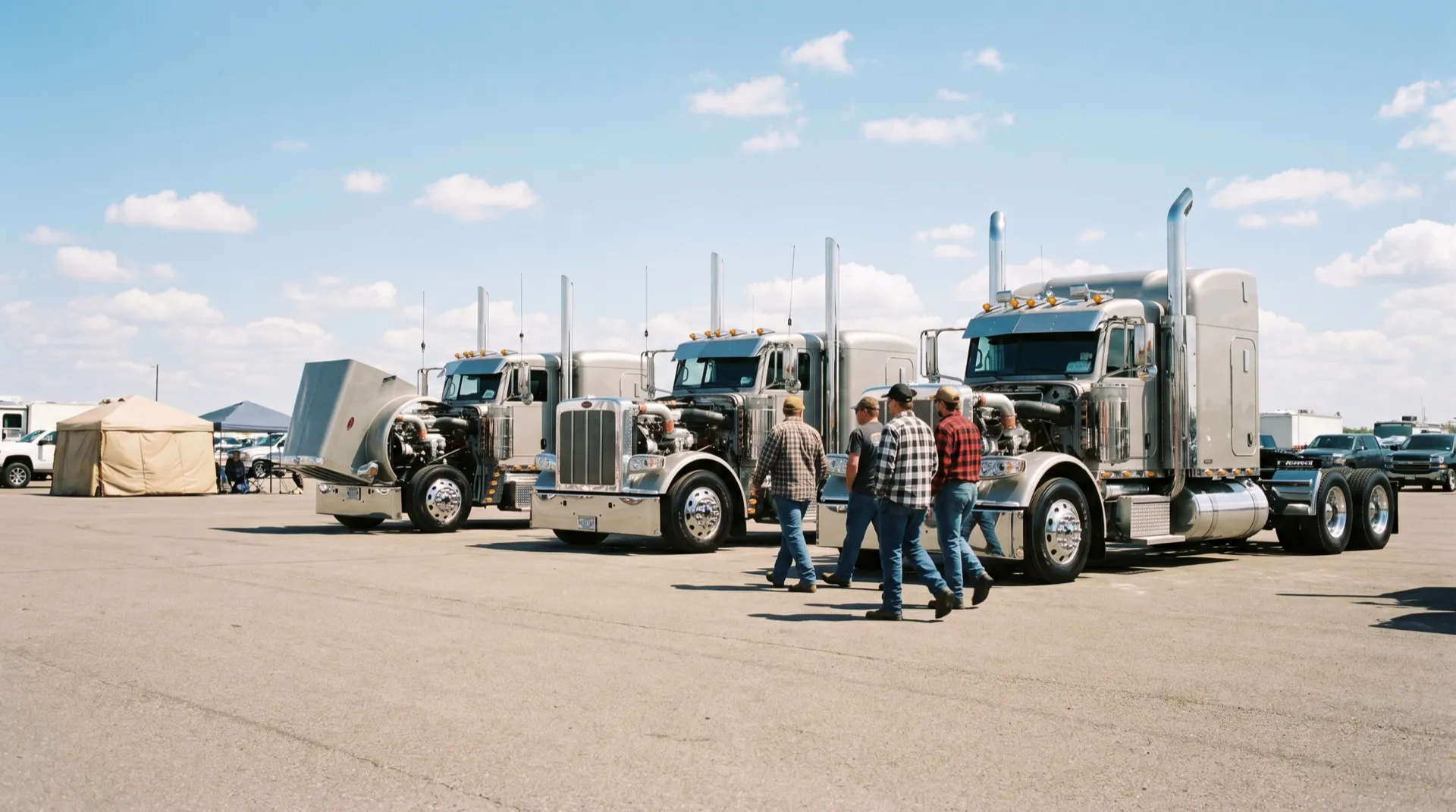
The Great American Trucking Show in Dallas, every August at the Kay Bailey Hutchison Convention Center, is the warmer of the two big shows. Smaller — roughly half of MATS in attendance — and more focused on owner-operators and small fleets. The Pride & Polish truck beauty contest at GATS is one of the few remaining real community draws in the show calendar; the trucks brought to GATS for Pride & Polish in 2025 represented some of the best preserved iron in North America. If you have to pick one of the two shows to attend as an owner-operator, GATS is the one we’d pick.
The Iowa 80 anchor
The Walcott Truckers Jamboree at the Iowa 80 truck stop, held every July, is the third major event in the trucking calendar and the only one that takes place at a truck stop rather than a convention center. It is a different kind of event — antique trucks, a working dog show, a country music stage, a fueling-island setup competition — and what makes it unusual is that the host is the truck stop itself. The Iowa 80 is the largest truck stop in the world and the Jamboree is its annual party.
For drivers who happen to be running through eastern Iowa in mid-July, it is worth routing through Walcott for the event. For drivers who would have to travel specifically to attend, it depends on your interest in the more nostalgic and lifestyle side of trucking culture. There is no equipment-buying angle. There is no carrier recruiting. It is, in the best sense, just a party for truckers, thrown by a truck stop. That is rarer than it should be.
Regional and association events worth knowing
OOIDA’s annual Truckin’ For Kids event in Hagerstown, Maryland is a smaller-scale gathering that draws a loyal owner-operator crowd, with proceeds going to children’s charities. It is one of the few events where the OOIDA leadership is genuinely accessible — president and board members are on-site, in the lot, talking to members. For owner-operators specifically, this is worth a trip.
The Women In Trucking annual Accelerate! Conference, held in different cities each year, has grown significantly in the last five years and is the leading event for women in the industry — drivers, fleet managers, and adjacent professionals. The 2026 conference is in Dallas in November.
For rideshare and gig drivers, the equivalent association landscape is younger and more fragmented. The Independent Drivers Guild in New York hosts regular member meetings, the Rideshare Drivers United organization in California runs a quarterly assembly in Los Angeles, and the Drivers Cooperative — a worker-owned rideshare platform — has built a real community presence in NYC that holds in-person events monthly. Outside those three markets, organized rideshare driver community is mostly online.
What’s quietly stopped being useful
Several truck shows that were significant a decade ago are now half-attended and limping along. We won’t name them out of professional courtesy, but the test is straightforward: if a show’s social media account hasn’t posted exhibitor news in 90 days, and the same vendor list ran the year before, you are looking at a coasting event.
Local truck stop “driver appreciation” events have largely degraded into vendor giveaways for cap stickers and chip clips. The exception is the Pilot Company’s annual driver appreciation week in September, which still has real engagement — fuel discounts, free showers, free meals at most locations — even if the carnival energy of the in-person events has thinned.
The online communities
This is where the real community work happens in 2026, and where the texture is.
TruckersReport is still the long-running forum that most working OTR drivers reference. The signal-to-noise ratio is moderate. The “Experienced Truckers Advice” subforum is the best section. The “Ask An Owner-Operator” megathread has running entries from drivers who post their financials month after month for transparency — it’s the closest the freight industry has to a public ledger of what owner-op life actually looks like.
r/Truckers on Reddit is more lifestyle-oriented than TruckersReport and significantly more cynical. Quality varies. Worth reading if you are early in your career and want to know what to actually expect; less useful for senior drivers who have heard most of the takes before.
r/uberdrivers and r/lyftdrivers are where the rideshare community lives online. The platforms changed too much over the last five years for the old Facebook groups to stay current — the Reddit communities have become the working drivers’ news source on app changes, pay structure shifts, and surge zone tactics. The market-specific subreddits (r/uberdriversnyc, r/rideshareLA) are even more useful for drivers in those markets.
TikTok is the place where younger drivers are doing community in 2026, and it is genuinely useful in ways that the trade press has been slow to recognize. The truck-tour videos, the day-in-the-life shifts, the gear reviews from working drivers — there is a real grassroots driver media culture there that exists in parallel to the trade publications, and increasingly the trade publications are repurposing what they see on TikTok rather than the other way around.
Discord is where small driver communities are organizing — owner-operator peer groups, dedicated lane discussion groups, gig courier coordination servers in larger metros. These are mostly invite-only and you have to know somebody. If you don’t know somebody, asking on Reddit is the usual entry point.
The honest takeaway
Most of the real community formation in the driver industry in 2026 is happening online and in smaller in-person settings — the OOIDA member events, the regional associations, the Discord servers, the truck stop bull sessions — rather than at the big trade shows. The big shows are still useful for what they are useful for: equipment, financing, and the once-a-year handshake circuit. But if you are looking for actual community, the energy has moved.