The I-40 corridor: a working guide from Barstow to Wilmington
Twenty-five hundred miles, eight states, and a few hundred truck stops. A working driver's guide to where to park, where to eat, and where to plan around on America's most-used east-west freight lane.
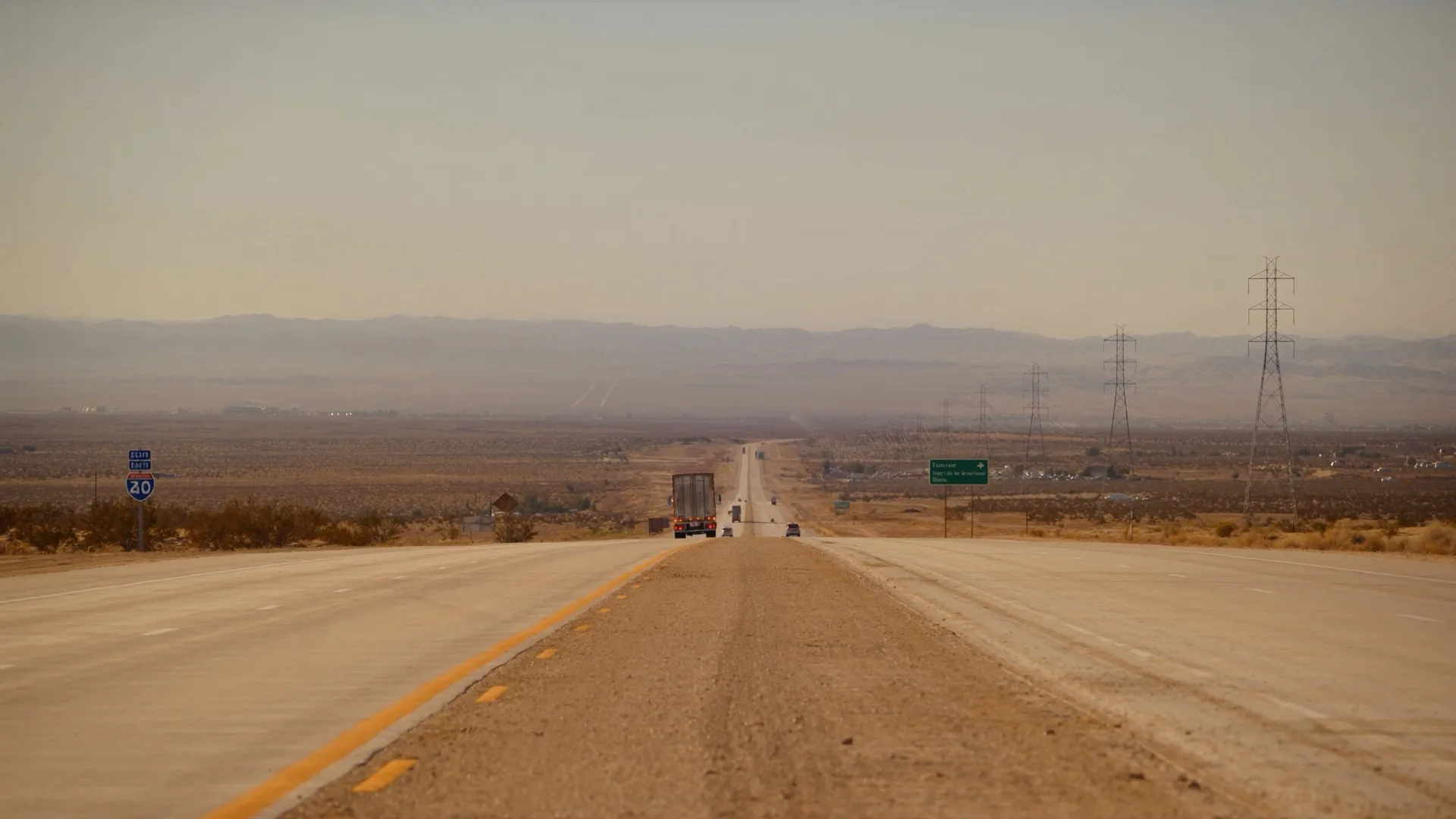
Interstate 40 begins, depending on how you count it, at the I-15 interchange in Barstow, California, and ends 2,555 miles later at the port at Wilmington, North Carolina. It crosses eight states. It is the most-trafficked east-west freight lane in the United States outside of I-10, and most working drivers reading this have already run it more times than they can count. This is not a beginner’s guide. It is a working note on what’s currently worth knowing on the lane in 2026 — where to park, where to fuel, where the construction is, and where to plan around.
Barstow to Flagstaff: the Mojave run
The first leg is the desert, and the desert is where rookies underestimate fuel planning. The Pilot at Barstow (Lenwood Road) is the last meaningful stop before you commit to the Mojave run; the next big stop is at Kingman, 210 miles east, and there’s not much in between except Needles. The TA in Kingman is the better of the two truck stops there — bigger lot, cleaner showers, the Country Pride is open 24/7. Diesel at Kingman tends to run higher than Barstow or Flagstaff; if you can stretch to Flagstaff you usually save money.
Flagstaff itself is worth the climb. The Love’s at Exit 198 (Country Club Drive) has reliable parking past midnight, even on weeknights, and the elevation drops your engine intake temps after the run up from the desert floor. The Little America at Exit 198 east is also a fine option if Love’s is full, especially in winter — they plow their lot.
Albuquerque to Amarillo: the wind and the meth checkpoint
Eastbound out of Albuquerque you have to think about wind. The stretch from Tucumcari, NM through the Texas panhandle is one of the most consistently windy on the entire interstate system, and dry vans are routinely held up at the New Mexico–Texas line on red-flag days. Plan to fuel at the Love’s at Santa Rosa (Exit 277) or push to the TA at Adrian, TX (Exit 22) — both have wind-protected fuel islands and good parking.
The Border Patrol checkpoint between Las Cruces and Lordsburg on I-10 doesn’t apply on I-40, but there is a USBP checkpoint at Sierra Blanca that some southbound traffic feeds into. On I-40 itself the enforcement to plan around is the New Mexico Motor Transportation Police at the port of entry at Glenrio. They are strict on hours-of-service paperwork — if you are at all close on your 14 they will know.
The Big Texan in Amarillo is the famous tourist stop, but the truck-actual stop is the Petro at Exit 75 (Lakeside). Big lot, decent food, fuel pricing usually competitive with Oklahoma. The Flying J at Exit 64 is a viable alternative but is harder to get in and out of for 53-foot trailers.
Oklahoma City to Memphis: the heart of the lane
This is where I-40 starts to feel like an interstate again — denser traffic, more freight, more dispatch density. OKC has multiple options; the OnCue at the I-40/I-44 junction is a fueling stop only (no parking), but it’s reliably the cheapest diesel in the metro. For parking, the Loves at Choctaw (Exit 166) is the standard pick eastbound; the lot fills by 8 PM most weeknights so plan accordingly.
The stretch between Henryetta and Sallisaw, OK is straight, fast, and dotted with smaller truck stops — Lucky’s at Webbers Falls is a regional favorite that’s worth a stop if you’ve never been; the kitchen is honest. Avoid the southbound-only routing onto US-69 unless you are heading to Texas — it’s not faster and the road quality is worse.
Memphis itself is a chokepoint. The I-40 crossing of the Mississippi River at the Hernando de Soto Bridge has been a recurring construction headache for the last several years; check the TDOT and ARDOT alerts before you commit. The I-55 alternate via the Memphis–Arkansas Bridge is usable but adds time. Park west of the river at the TA at West Memphis, AR (Exit 280) rather than trying to find space inside the metro.
Nashville to Asheville: the hills
East of Nashville the road starts to climb. The grades through the Cumberland Plateau between Cookeville and Crossville are nothing dramatic but they will burn fuel on a heavy load — plan to fuel before the climb, not at the top. The Pilot at Crossville (Exit 320) is reliable; the TA at Knoxville (Exit 369) has the better restaurant but a tighter lot.
Asheville is the next significant elevation gain. The 6% grade descending eastbound from the Eastern Continental Divide between Asheville and Old Fort, NC is the steepest sustained downhill on the entire interstate. Brake check, low gear, and patience. There have been multiple runaway-truck incidents on this grade in the last decade, and the runaway ramps are well-marked but well-used. Do not be the next story.
Asheville to Wilmington: the coastal slide
East of the divide the topography flattens out and the lane becomes routine. Statesville and Greensboro are the major intermediate hubs; the TA at Mocksville (Exit 174) is the consensus best stop in central North Carolina, with a real driver’s lounge and a kitchen open till 11 PM. Raleigh has fewer truck-friendly options than its size would suggest — most drivers fuel and roll through rather than stop.
I-40 in eastern North Carolina actually ends at I-95 in Benson; from there to Wilmington you are on a four-lane that is still signed as I-40 but functions more like a state route. Parking near the Port of Wilmington is tight — the Pilot at Wallace (Exit 385) and the Wilco Hess at Magnolia are the two reliable options. If you are headed for a port appointment, get there the night before. The morning queue at the Port of Wilmington gate has gotten significantly longer in 2026 since the terminal expansion broke ground.
Three things to plan around in 2026
First, the I-40 Mississippi River bridge work in Memphis is real and is likely to involve intermittent lane closures through at least the third quarter of 2026. Build a buffer.
Second, fuel pricing on the lane has decoupled in 2026 in ways it didn’t in prior years. Oklahoma diesel is consistently the cheapest stretch of the entire lane; New Mexico and California are consistently the most expensive. Plan to fill in OKC and stretch westward into California rather than fueling in California if you have the choice.
Third, parking pressure on the lane is the worst it has been in a decade. The lots in Albuquerque, Amarillo, OKC, and West Memphis all fill earlier than they used to. If your trip plan has you arriving at one of these around 8 PM or later, you are competing for fewer spaces than the historical norm. Call ahead or use the major chain reservation systems — Pilot Reserve, Love’s, TA — and budget the parking fee. It’s cheaper than the alternative.
The road is what it is. The lane is what it is. The difference between a hard run and an easy run is almost always the planning that happened before the truck left the dock.