Voices from the night shift: four drivers on the quiet half of the day
An OTR driver in Wyoming, an Amazon DSP in Phoenix, an Uber driver in Manhattan, and a Walmart Spark courier in Atlanta on what changes when the sun goes down. Composite portraits, drawn from conversations with multiple drivers in each role.
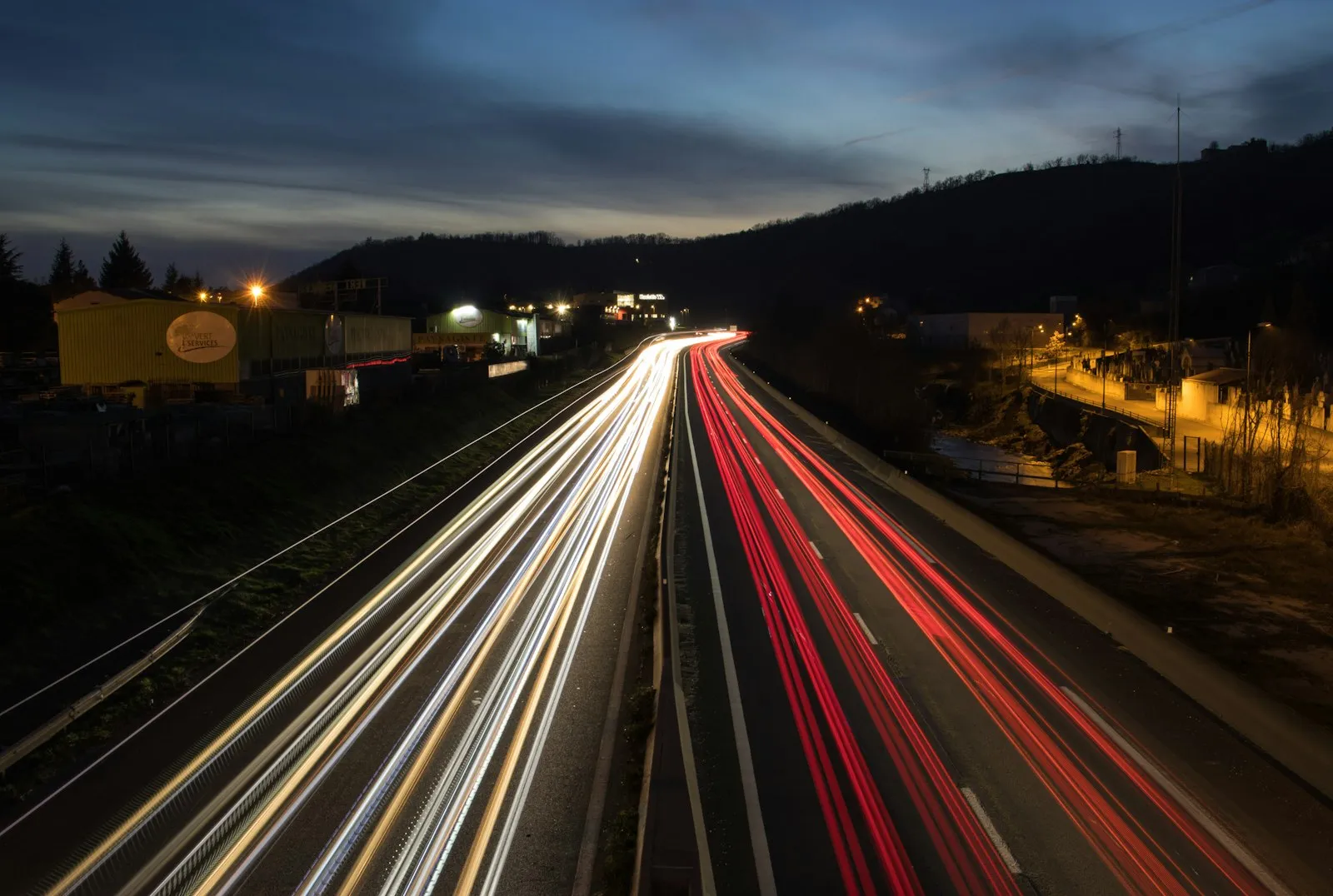
The night shift is not really one shift. It is four or five different kinds of work that happen to share a sky. For our composite portraits below we spoke with several drivers in each category — long-haul, last-mile, urban rideshare, and gig courier — and constructed representative voices that condense what we heard. Names, details, and small biographical particulars have been changed to protect the drivers who spoke with us. The texture is real.
What follows is not a quote in the traditional sense. It is a synthesis. Read it as fiction in the way that all composite journalism is fiction — true in pattern, simplified in specifics.
Carl, OTR reefer driver, running I-80 through Wyoming
The night is when the road actually makes sense. I prefer it. The traffic thins after 9 PM in most of the country, the four-wheelers go home, the DOT enforcement is lighter at certain weigh stations, and on a clear cold night through Wyoming you can hold 65 from Cheyenne to Rock Springs without seeing anything but other trucks and the antelope.
The thing nobody outside the cab understands about night driving is that it’s not the dark that’s tiring. It’s the same hours your body has been telling you to sleep for thirty or forty years. You can build up to it — most night drivers have a routine, you sleep through the morning, you eat your big meal in the early afternoon, you start your shift around 6 PM — but you never really stop fighting your own circadian clock. The day drivers think they’re working harder because they’re in traffic. The night drivers are working harder because they’re working against their own biology.
I do a lot of audiobooks. Country music in the bad stretches. A thermos of cold brew I make at the truck stop in the morning before I sleep, so it’s ready when I wake up.
Maria, Amazon DSP driver, Phoenix metro
The night routes in Phoenix in summer are why I switched. Doing rabbit routes — that’s what we call the high-stop-density residential blocks — in 115-degree heat in July, I was losing five pounds of water a day. I asked for a night route the first chance I got, and once I had one I never went back.
The night routes are different work. Fewer customers home, which means more “deliver to mailbox” or “leave at door” — easier and faster — but you also have fewer eyes on you, which the DSP makes a real point about for safety reasons. We’re supposed to call dispatch on any address that feels off after dark. I do. Some drivers don’t.
The biggest thing nobody tells you about night DSP work is the dogs. Day routes, the dogs are inside, or the owners are home. Night routes, the dogs are out in the yard, sometimes unsecured. I’ve been chased twice this year. The company gives us a dog horn. It works about half the time.
I make a little less per route than the day drivers because the routes are usually shorter and less dense. But I get home by 2 AM and I sleep until my kid’s school bus, and that’s worth the difference to me.
Davis, Uber driver, Manhattan
The night is the only Uber work that actually pays in Manhattan in 2026. Day work — the airport runs, the meetings, the medical appointments — pays out, but the surge multipliers during the day are nothing compared to what you can clear on a Friday or Saturday between 11 PM and 4 AM. I run two shifts: late afternoon for two hours, then a long night shift from 9 PM to 4 AM. Five nights a week.
You learn the geography. The cluster on the Lower East Side around 1 AM. The Midtown surge when the shows let out. The Hamilton Heights and Washington Heights runs at 3 AM that pay double base because nobody else will take them. The airport surge starting at 4 AM. I worked white-tablecloth restaurants for twelve years before I started driving and the night work is not unfamiliar to me. The same people, the same energy, the same arc of the evening from controlled to less controlled.
The rideshare driver who drives daytime is doing a different job than I am. We just happen to share an app. I’ve been doing this six years. The night drivers all know each other. We park at the same lots between rides, we share intel on surge, we look out. There’s a community there that the company doesn’t really see and I don’t think they understand.
Shay, Walmart Spark courier, Atlanta
I work nights because I have a day job. That’s most Spark drivers, honestly. We’re not full-time gig workers. We’re people with W-2 jobs doing this on the side, and the night shifts are when we can.
I start around 7 PM after my regular shift, hit a few Walmart pickups, run them out, and I’m usually done by 11 PM. Most of my batches are grocery deliveries — somebody who ordered after work and wants it that evening. The pay is okay. Not great. The mileage adds up against your car, which is the thing the platform doesn’t really account for in its earnings projections, and which is the conversation every couples-table at every drivers’ meetup ends up having.
Spark is good for what it is. It’s not a career. It’s a way to put $400-$600 a week on top of a regular paycheck if you’re willing to spend your evenings doing it. I am, for now. My partner and I are saving for a down payment, and the Spark money is the down-payment money. When we close on a house I will probably stop.
The Walmart store I work out of has a back loading area where the Spark drivers line up after 9 PM. It’s almost always the same crew. We don’t really talk much. Everyone is tired. But there is something about waiting in that line at 9:30 PM with seven other drivers doing the same thing for the same reasons that makes the work feel less lonely than it might otherwise.
What the four shifts share
The drivers we spoke with across all four categories described the same handful of things in different vocabularies. The quiet. The light traffic. The biological cost of inverting your sleep schedule. The version of the city or the highway that you see at 2 AM that nobody who works days really sees. The community of other night workers — gas station clerks, ER nurses on shift change, the bakers and the warehouse loaders — that becomes its own small world.
The night shift is not better or worse than the day shift. It is a different job, done by different people, for different reasons. It is, in 2026, increasingly the half of the driving economy that’s growing fastest. The freight moves at night. The deliveries go later. The rideshare surges have gotten more nocturnal as the daytime ride economy has thinned. The drivers who are taking the night work are doing it deliberately, and most of them are not interested in switching back.